|
Automation
of the wet disinfection process during the production of suture threads from
natural collagen, catgut
|
Automatización de la desinfección durante el
proceso húmedo de producción de hilos de sutura quirúrgico a partir de
colágeno natural, catgut
|
|
Juan A. Vega Farje  1, Ana Gonzalez 2 and Fanny L. Casado 1, Ana Gonzalez 2 and Fanny L. Casado  3* 3*
|
1 Mechanical
Engineering, Pontificia Universidad Catolica del Peru, Lima, Peru.,
juan.vegaf@pucp.edu.pe
2 Department
of Engineering, Pontificia Universidad Catolica del Peru, Lima, Peru.,
agonzal@pucp.edu.pe
3 Institute of Omic Sciences and Applied Biotechnology,
Pontificia Universidad Catolica del Peru, Lima, Peru., fanny.casado@pucp.edu.pe
* Autor de correspondencia
Abstract
Surgical sutures are the
simplest yet most used medical devices in modern healthcare, they are the preferred type because of its biocompatibility and ability to be resorbed.
Bovine intestinal fibers are converted into catgut that serves as the starting material of absorbable
surgical suture threads. The mechanical and control subsystems of industrial
equipment were designed
to automate disinfection of bovine intestinal fibers to increase efficiency during the wet process stage of disinfection without altering its fiber quality. A
turbulent regime of the water and disinfectant mix was designed, implemented and validated, this automatic aeration
system in the disinfection thank increased the process efficiency
by reducing the time
used to handle a load of fibers by
50%, and the working time of the personnel involved
in the process was reduced from 220 to 20 minutes. Tests on the final product showed that LAL levels comply with
what is established by the American Pharmacopoeia: USP <85>
Bacterial Endotoxin Test and USP <161> Medical Devices - Bacterial
and Pyrogen Endotoxin Test. These results indicate that the disinfected catgut using
the proposed automated system complies with
all mechanical quality control tests.
Keywords: design for manufacture, control design,
industrial bioprocessing, medical
devices
Resumen
Las suturas quirúrgicas son
los dispositivos médicos más simples, pero más utilizados en la atención médica moderna, son el tipo
preferido debido a su biocompatibilidad y capacidad de reabsorción. Las fibras intestinales bovinas se convierten en catgut que sirve como material de partida de hilos de sutura quirúrgico absorbibles. Los subsistemas mecánicos y de control
de los equipos industriales
fueron diseñados para automatizar la desinfección de las fibras intestinales bovinas
para aumentar la eficiencia durante la
etapa del proceso húmedo de desinfección sin alterar la calidad de la fibra. Se diseñó, implementó y validó un régimen turbulento de la mezcla de agua y desinfectante,
este sistema de aireación automática en el tanque de desinfección
aumentó la eficiencia del proceso al reducir en un 50% el tiempo de manipulación de una carga de fibras,
por ello el tiempo de trabajo del personal involucrado en el proceso se redujo
de 220 a 20 minutos. Las pruebas
sobre el producto final mostraron que los niveles
de LAL cumplen con lo establecido
por la Farmacopea Americana: Prueba de Endotoxinas Bacterianas USP <85> y Dispositivos Médicos USP <161>
- Prueba de Endotoxinas Bacterianas y Pirógenas. Estos resultados indican que el catgut
desinfectado utilizando el sistema automatizado propuesto cumple con todas las pruebas de control de calidad mecánico.
Palabras clave:
diseño para fabricación, diseño de
sistema de control,
bioprocesamiento industrial, dispositivos médicos
Introduction
Catgut sutures
are manufactured from the submucosal layer of the serosal layer of the small intestine of cattle. This type of
sutures from a biological source is used in most surgeries because it is 100% resorbed by the human body (Chu, 2013). Current
protocols involved are highly manual and there are not commercially
available solutions for their automatization which may result in increased
reproducibility, reduced disinfectant usage, optimized time
efficiency and suitable ergonomics for the operators. The process involves
wet and dry stages, where the fibers are first cleaned with aqueous solutions
to reduce the bacterial load derived from the cattle microbiome present in their intestines. Next, the
fibers are treaded to become filaments that will be dried, polished and packaged to serve as raw material to make
resorbable surgical sutures through
further processing (Holder,
1949). The purpose
of this work is to automate
some washes and rinses using a turbulent regime to increase the efficiency of the disinfection process
(Juszkiewicz, Walczak, Mazur-Panasiuk, & Woźniakowski, 2020). There are several methods used in
industrial processes for the agitation and mixing of homogeneous liquids.
The use of a tank with an agitator impeller and baffles
is widely used in industrial processes for the blending of miscible
fluids, high viscosity blending, solid suspension or dissolution and liquid-liquid dispersion, among others (Weetman
& Gigas, 2002). However, these mixer tanks are usually enclosed systems that may not easily accommodate the
bundles of fibers from the intestines and will be hard to clean and maintain. They can also damage the surface of
the catgut fibers, reducing their strength. Therefore, for our design,
we decided to use aeration
as a better alternative than using an impeller. Aeration
methods introduce a gas through
pipes inside the liquid by controlling parameters like gas pressure,
tank size or the size of the holes on the pipe. In our proposed system the mixing is achieved
by the turbulence generated through air bubbles emerging to the
surface. We describe the proposed mechanical design of an aeration
tank for disinfection, its prototyping, and implementation in the production
plant of the company STC Peru in
Lima, Peru.
Materials y methods
System design
and implementation
We followed
guidelines of the standard VDI2206 "Design methodology for mechatronic systems" (Verein Deutscher
Ingenieure, 2004). To understand the system's imperatives, a requirement list containing
the essential information was elaborated, as shown in Table 1. The primary consideration was
the turbulence generation inside the mix tank for both mixing and agitation of water and disinfectant.
The
system had to be designed so that it
is easy to automate, maintain, and repair. It was also crucial that the
proposed turbulence generation system does not introduce foreign
materials to the tank nor damage
the catgut fibers. The system proposed in this document seeks to replace a manual agitation method, as it is going to
be detailed in the following paragraphs. Although in the catgut
fiber process is not necessary to mix liquids
with a gas, the introduction
of an aeration system with filtered air can aid in the generation of liquid turbulence for mixing and agitation.
Table 1
Requirement List for the
System
|
|
|
|
Description
|
Requirements
|
|
Main function
|
Contain
and allow the bath of 6, 3.4,
and 1.04 meter
long fiber bundles.
|
|
Geometry
|
Have the necessary
dimensions to hold the 80 cm wide slats that hold the 6, 3.40 and 1.04 meter
long fiber bundles.
Hold up to 4 levels of slats with catgut fiber bundles arranged one on top of the other,
reaching a minimum
water height of 6 cm and a maximum water
height of 15 cm.
|
|
Process
|
The water and
disinfectant mix inside the tub must be in a turbulent regime to facilitate
the germicidal product's impregnation and its action on all the filaments immersed in the
tub.
|
|
Automation
|
To fill the tub automatically by activating the ignition and controlling it with
a water level sensor.
To control compressor start, run time,
and shutdown to generate turbulence.
|
|
Maintenance
|
Maintenance should
be easy to perform and preferably modular (tank, water turbulence system, automation system)
|
|
Energy
|
Allows the system to be
connected to the company's electrical network which are single-phase 220V and three-phase 380V.
|
|
Safety
|
Systems must be safe for operators in accordance with
current occupational safety
regulations.
|
System validation
After building the automated
disinfection system, chlorhexidine gluconate and benzalkonium chloride were tested
separately to verify the effects on the strength of the fibers cleaned with widely used disinfectants. The tests were
carried out at the plant located in the district of Santa Anita, Lima, Peru with an ambient temperature of 18°C
and 76% relative humidity. The automated aeration
used lasted 20 minutes to promote optimal contact of the solution with the fibers. This time was established based on
preliminary tests with inorganic dyes to observe
the homogeneous coating of the surface of all the fibers without causing the disruption of the integrity of the
filaments, as visually verified by the factory's quality control experts. Then, the filaments were rinsed and twisted to
establish their caliber. After that,
they were moved to the drying zone, in rooms equipped for drying at relative humidity gradients.
Then,
the resulting catgut filament was tested using routine quality control tests including caliber size,
tensile strength and endotoxin levels. The standard size of 75 cm was chosen with tolerances of 5%. The p-values for
the differences between the caliber
or resistance values were calculated using the t-Student test in the control groups of each of the two batches.
A two-tailed distribution was assumed and that significant differences occurred for p <0.05.
Results
Prototype
The team assembled a prototype of the aeration system that consisted of a closed circuit of
polyvinyl chloride (PVC) piping connected to an air blower. The piping circuit had holes directed to the water surface
for the compressed air to escape and generate
the desired turbulence. The circuit was submerged close to the bottom of
a fiberglass tank previously used by
the company for the same purpose of this work. Although it is not automated,
the prototype helped to understand the different
process steps and times involved in
the whole process.
A
comparison of the process steps tested between
the company's old method (manual method) and the new method that uses
compressed air (aeration method) is
shown in Table 2. Photographs of the prototype disposition and testing can be reviewed in the Appendix A.
The
prototype allowed a reduction of 53% for the processing time of four fiber
bundles and 50% in processing eight fiber bundles. Likewise, two workers' time on the manual method is 120 minutes
each for processing eight bundles,
making a total of 240 minutes. In contrast, with the prototype aeration method,
a single worker
uses 20 minutes for the same job. Thus, it is concluded
that 220 minutes of labor
would be available to attend other processes co-occurring in the plant. Additionally, the water and
disinfectant mixture increased its performance from being used for a bundle of four slats to being used in two
bundles. This improvement also saves the company 50% of the disinfectant cost.
Table 2
Units for Magnetic Properties
|
|
|
|
|
|
|
Step
|
Manual method
(MM)
|
MM step durat.
|
Prototype aeration method
(PAM)
|
PAM step duration
|
|
1. Water filling
|
The tank is filled
with water to cover
four fiber bundles (15 cm
of water). The disinfectant product
is also added.
|
10 min
|
Same as the manual method
|
10 min
|
|
2. Water & disinfection mixing (before adding fibers)
|
Two workers using acrylic plastic paddles proceed to
shake the water manually to mix both
components
|
10 min
|
One worker
places the closed
circuit of pipes
and the blower is turned on for 5 minutes to mix the water
with the disinfectant.
|
5 min
|
|
3. First batch disinfection
|
Four bundles with catgut
fibers are placed inside the tank
and the two workers stir the water.
|
40 min
|
Four bundles with catgut
fibers are placed inside the tank and the
blower is turned
on to generate the turbulence of the
water.
|
20 min
|
|
4. Second batch disinfection
|
Steps 5, 1, 2 and 3 have
to be performed again.
|
75 min
|
The first batch of four
bundles of fibers is retired and
new 4 bundles are installed in five minutes. Then, the disinfection is carried out again
in 20 minutes.
|
25 min
|
|
5. Draining
|
The
four fiber bundles are removed and the
tub is emptied by opening the valves manually.
This takes 15 minutes to leave the
tub rinsed and clean. The water and disinfectant mixture is only used
once.
|
15 min
|
Same as the manual method
|
15 min
|
|
|
Manual method
duration for 2 batches of four fiber
bundles:
|
150 min
|
Prototype aeration method duration for 2 batches of four fiber bundles:
|
75 min
|
Implementation
The mechanical and control
design of the disinfection system for
catgut fibers was developed based on the
prototype results. The system is composed of a mix tank, the support structure, the aeration system to
generate water turbulence, and the automation
system. Figure 1 shows an isometric drawing of the proposed system
prepared using a computer-aided Design
software. The pipes of the aeration system
were fastened to the
mix tank through clamps to prevent them from floating. To stay under the catgut fibers, they were attached in the
longitudinal extremes of the tank. These
details are shown in Figure 2. The
air inlet was connected to a compressor that does not use oil, and drivers were included in the
automation system. The automation system replaced many of the manual tasks that were initially performed by the
workers in the manual method process.
Figure 1
Isometric
view of the disinfection system
drawn in a CAD software.
Figure 2
Isometric
view of the supports for the
catgut slabs, the aeration system piping, the clamps supporting the aeration
system and the pipes that connect to the air compressor
The sequence and order
of these activities and how they were
automated in the project are detailed in Table
3.
Table 3
Automation of the system steps
|
|
|
|
|
Step
|
Manual Method
|
Automated method
|
|
Water filling
|
A worker had to manually
open the water inlet valve and
monitor that the
water level reaches the necessary mark.
|
The
water inlet valve will be activated with a push button and a water
level sensor will
automatically make the valve
close when the
desired level is reached.
|
|
Water and disinfectant pouring
|
A worker will place
the mixture manually while the tank is filled with
water.
|
Same as the manual method.
|
|
Water and disinfectant mixing
|
Two
workers will mix the water and disinfectant
using paddles for 10 minutes before loading the fibers.
|
A worker will activate the aeration system by pushing a button. It has a timer of 5 minutes before it turns
off.
|
|
Disinfection
|
Two workers will generate turbulence for 40 minutes.
|
A worker will activate the aeration system by pushing a button. It has a timer of 20 minutes
before it turns
off.
|
|
Draining
|
Once the disinfection has
been completed, the workers must
check the fibers and determine if they
need a few more minutes or if they are satisfied with
the disinfection. If they are, they will
manually open the
tank discharge valves.
|
Once the disinfection has
been completed, the worker must
check the fibers and
determine if they need a few more minutes or if he is satisfied with the disinfection. If he
is, he will activate the button for the
tank discharge valves.
|
a.
The mixing
tank
The design of the
mixing tank was mainly based on meeting the geometric and process requirements. It had to contain up to four
bundles of 6-meter-long catgut fiber slats, reaching
a minimum mix level of 6 cm and a maximum of 15 cm. For this purpose, the material proposed was AISI 316 stainless
steel, ideal for resisting corrosion of mixtures with a wide pH range, be it basic or acid. It was assembled
using 14-gauge sheets and reinforcing
gussets will be placed on the sides to prevent deformation. At its ends, it
will have two 1 1/2” pipes in which
they will be coupled to the discharge valves. The tank will be mounted atop of the support structure.
b.
Supporting Structure
The structure
supporting the tub was made of 2”x 2” square tubes made of ASTM A500 steel and joined by welding.
After the manufacturing process, it was coated with anticorrosive paint to protect
it from the high humidity
environment. This structure
supports the tub and houses the electrical panel. The structure
must support the maximum
load when the tub is complete with catgut threads and filled to the maximum with water.
c.
Aeration System
Since there was no need for a
specific bubble size to produce the mix turbulence, to ease the fabrication, the set of pipes were made up of a closed
circuit of ½” PVC pipes with ¼” holes
to allow the air escape along the entire upper part of the pipe, at 50 mm intervals
(Figure 3). The circuit
was linked to an air compressor that works without
oil so that the incoming air is clean and free of contamination. The
compressor has a motor power of 2HP and 50 liters of capacity
in its inlet tube.
Figure 3
Isometric detail view of the aeration system.
d.
Control Design
The main purpose
of the automation system is to facilitate the use of the disinfection system for catgut fibers. A programmable
logic controller (PLC) is used to control the
water pouring, to command the compressor that generates turbulence through the aeration system, and to open and close
the valves for the tub draining. The schematics of the electrical connections are found in the Appendix B.
First, the system is protected with a thermo-magnetic switch and a differential switch for any eventual overload.
Related to this safety issue, it is mandatory that the system is grounded
to avoid any accident or fatality,
especially in an environment with abundant water. The power supply powering the PLC, sensors and actuators
were grounded in the same way. A differential
switch was added to the compressor connection for safety and to protect
said equipment. The system
consists of a water level sensor that conditions the activation of the compressor; the compressor only
activates if there is a minimum of water in the tub, calibrated to the desired values of 6 and 15 cm. When the sensor
condition is met and the corresponding button is activated, the compressor is activated for the time programmed
in the PLC. If there is an emergency stop desired during the compressor activation time, the stop button can be
activated to stop the compressor immediately.
There is a third on/off selector that activates the discharge valves as long as the compressor is not active.
The automatic
filling system of the tub is controlled by an on/off inlet valve. To activate it, the
corresponding button must be pressed. When the
water level sensor detects a sufficient level, it automatically closes the inlet valves. As a
safety measure, the Stop button also stops this action. The control panel
contains all the buttons and
selectors of the system. This panel must have an IP65 degree of protection for dusty environments and against low power jets of water.
Validation
After building
the automated disinfection system, chlorhexidine gluconate
and benzalkonium chloride were
tested separately to verify the effects on the strength of the fibers cleaned with widely used disinfectants. The details of the disinfectants are presented in Table
4. The tests were carried out on Saturday, October 3 2020 at the facilities of the plant located in the
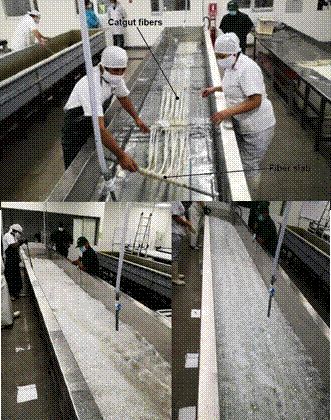
district of Santa Anita, Lima, Peru with an ambient temperature of 18°C and 76% relative humidity. The pictographs
of the loading and testing process
are in the Appendix C.
Table 4
Disinfectants Tested
|
|
|
|
|
Trade name,
brand, batch and expiration date
|
Chemical composition
|
Dilution (%)
|
|
Safe Blon H 1.5%,
Roker, 11217138, December 2021
|
Chlorhexidine gluconate, 1.5%.
|
0.0015%
|
|
Safe Green 5%, Roker, No.10416029, April 2022
|
Benzalkonium chloride, 5%
|
0.005%
|
The automated
aeration used lasted 20 minutes to promote optimal contact of the solution with the fibers.
This time was established based on preliminary tests with inorganic dyes to observe the
homogeneous coating of the surface of all the fibers without causing the disruption of the integrity of the
filaments, as visually verified by the factory's
quality control experts. Then, the filaments were rinsed and twisted to
establish their caliber.
After that, they were moved to the drying zone, in rooms equipped for drying at relative humidity gradients. Then, the resulting catgut filament was tested using
routine quality control tests including caliber size, tensile strength and
endotoxin levels. The standard size
of 75 cm was chosen with tolerances of 5%. The results of the validation tests of the gauge and tensile
strength of the threads that were subjected to
the different disinfectants are shown in Table
5.
Table 5
Caliber (MM) Tensile Strength (KG.F). N = 13 filaments1,2
|
|
|
|
|
|
Treatment
|
Catgut:
caliber, batch
|
Average and caliber
range (mm)
|
Average
and strenght range (kg.f))
|
|
Control
|
0 – 2090010
|
0.495 [0.494 - 0.497]
|
3.84 [3.07 - 4.17]
|
|
Control
|
0 – 2090020
|
0.495 [0.490 - 0.496]
|
3.60 [2.72 - 4.10]
|
|
Chlorhexidine gluconate
|
0 - 2090010
|
0.495 [0.493 - 0.497]
|
3.84 [3.32 - 4.14]
|
|
Benzalkonium chloride
|
0 - 2090020
|
0.495 [0.492 - 0.497]
|
3.71 [2.74 - 4.30]
|
|
Control
|
2/0 -
2090010
|
0.395 [0.393-0.396]
|
2.57 [2.18 - 2.80]
|
|
Control
|
2/0 -
2090020
|
0.395 [0.394 - 0.397]
|
2.60 [2.00 - 2.97]
|
|
Chlorhexidine gluconate
|
2/0 -
2090010
|
0.395 [0.392 - 0.396]
|
2.33 [1.78 - 2.88]
|
|
|
|
|
|
Benzalkonium chloride
|
2/0 -
2090020
|
0.395 [0.394 -0.396]
|
2.45 [2.00 - 2.72]
|
|
|
|
|
1 For a 0 caliber, according to the standard, the gauge diameter
shou ld be between
0.400-0.499 mm and the
average tensile
strength should be > 2.77 and the minimum > 1.45
2 For a 2/0 caliber,
according to the standard, the gauge diameter
should be between
0.350-0.399 mm and the average
tensile strength should be >2.00 and the
minimum >1.04
It
was found that for calibers 0 and 2/0 product conformity was given in all
cases. The p- values for the differences between the caliber
or resistance values
were calculated using the t-Student test in the control
groups of each of the two batches, as shown on
Table 6. A two-tailed distribution was assumed and that significant
differences occurred for p
<0.05. It was concluded that there were no significant differences in the
values of these variables for any
of the batches.
Table 6
Calculations of the p-value of the T-Student Test for the
control group of each batch (2090010 vs. 2090020)
|
|
|
|
|
Caliber
|
Diameter
|
Tensile strength
|
|
Caliber
0
|
0.7370
|
0.1672
|
|
Caliber 2/0
|
0.1145
|
0.7118
|
Table 7 shows the p-values for ANOVA comparing
benzalkonium chloride and chlorhexidine
gluconate disinfections assuming that the samples were not paired and that the distributions of the standard
deviations were comparable. For the 2/0 caliber there is a notable effect with the disinfection performed. Then,
the t-Student test was used to evaluate independently each disinfectant, finding
that for chlorhexidine gluconate there was a significant difference in the tensile
strength of the threads with respect
to the control (p = 0.0166) while there were no differences for benzalkonium chloride.
Table 8 shows a summary
of the results of the LAL levels according to what
is established by the American
Pharmacopoeia: USP <85> Bacterial Endotoxin Test and
USP <161> Medical Devices - Bacterial and Pyrogen Endotoxin Test. These
results indicate that the
disinfected catgut using the automated system passes all mechanical quality control tests. However, the
experiments were not designed to establish whether there is decreased endotoxin levels based on specific treatments.
Table 7
ANOVA p-value calculations
|
|
|
|
|
Caliber
|
Diameter
|
Tensile strength
|
|
Caliber
0
|
0.3789
|
0.6506
|
|
Caliber 2/0
|
0.8212
|
0.0382
|
Table
8
Endotoxin levels (EU / device)
|
Treatment
|
Catgut: caliber,
batch
|
Quantitative result
(EU / device)
|
EU / device
specification <20
|
|
Control
|
0
– 2090010
|
11.3
|
Passed
|
|
Control
|
0
– 2090020
|
8.8
|
Passed
|
|
Chlorhexidine
gluconate
|
0
- 2090010
|
11.3
|
Passed
|
|
Benzalkonium
chloride
|
0
- 2090020
|
10.0
|
Passed
|
|
Control
|
2/0
- 2090010
|
10.0
|
Passed
|
|
Control
|
2/0
- 2090020
|
10.0
|
Passed
|
|
Chlorhexidine
gluconate
|
2/0
- 2090010
|
10.0
|
Passed
|
|
Benzalkonium
chloride
|
2/0
- 2090020
|
10.0
|
Passed
|
Conclusions and Discussion
Our team successfully completed
the mechanical and control design of industrial equipment that allows efficient automated
disinfection of bovine intestinal fibers for catgut suture thread manufacture. The
design uses an aeration system that generates
the necessary turbulence to properly disinfect the catgut fibers.
In-situ testing of the system was
also performed using two widely used disinfectants with satisfactory results. The automatic aeration
system in the disinfection tank implemented increased
the process's efficiency by
reducing the time used to process a load of fiber by 50%. The system also allowed the mixture of water and
disinfectant to improve its utilization performance by 100%. Finally, the work
time of the personnel used in the process was
reduced from 220 to 20 minutes. From the prototype results that were
replied by the implemented system,
the design allowed a reduction of 53% for the processing time of four fiber bundles and 50% in processing
eight fiber bundles. A single worker uses 20
minutes for processing eight fiber bundles while it took two workers 120 minutes each for the same job. Thus, it is concluded that 220 minutes of
labor would be available to attend
other processes co-occurring in the plant. Additionally, the water and
disinfectant mixture increased its
performance from being used for a bundle of four slats to being used in two bundles. This improvement also
saves the company 50% of the disinfectant cost.
It is important to mention that the engineering solution provided is relatively
simple yet robust from a mechanical design and automation technical perspective.
Therefore, it addresses the requirements while maintaining the value of the
product which is a critical component to move forward any innovative efforts.
Acknowledgements and funding
information
We want to show our appreciation to the technical
and administrative personnel
of STC
S.A.C. They were enthusiastic about designing and implementing the disinfection system and helped enormously through the
whole process. We would also like to thank Edwin Alvarez
Valdivia, who greatly
helped in the engineering and implementation ofthe processes' automation. Finally, we
are grateful to Etsel Suarez Uribe for his critical reading and feedback
of the manuscript.
This work was
supported by the Ministry of Production of Peru thorugh the Programa Nacional de Innovacion para la
Competitividad y Productividad INNOVATE PERU Grant No.306-PIEC1-2019.
Contribution to authorship
Juan A. Vega Farje wrote the
manuscript, executed experiments and analyzed data. Ana Gonzalez wrote the manuscript, executed
experiments and analyzed
data.
Fanny L. Casado critically
revised the manuscript, executed experiments, analyzed data and secured funding.
Conflicts of interest
The authors have no
conflict of interest to declare.
References
Chu, C. C. (2013). Materials for absorbable and nonabsorbable surgical sutures. Biotextiles As Medical Implants, 275–334.
https://bit.ly/3lUAdJq.
Holder, E. (1949). The story of catgut. Postgraduate Medical Journal, 25, 427–433. https://doi.org/10.1136/pgmj.25.287.427.
Juszkiewicz,
M., Walczak, M., Mazur-Panasiuk, N., &
Woźniakowski, G. (2020). Effectiveness of Chemical Compounds Used
against African Swine Fever Virus in Commercial
Available Disinfectants. Pathogens (Basel, Switzerland), 9(11),
1–10. https://doi.org/10.3390/PATHOGENS9110878.
Verein
Deutscher Ingenieure. (2004). DIN - VDI 2206
- Design methodology for mechatronic systems.
Dusseldorf. https://bit.ly/3zENaMl.
Weetman, R. J., & Gigas, B. (2002).
Mixer Mechanical Design - Fluid Forces.
Texas: Texas A&M University. http://oaktrust.library.tamu.edu/handle/1969.1/164026.
Appendix.
APPENDIX A: PROTOTYPE
AERATION METHOD PICTURES
Figure A1
Water pouring
Figure A2
Air blower
connection to the aeration system
Figure A3
Water turbulence generation by blowing air to the system in empty tank
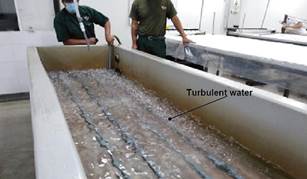
Figure A4.
Catgut fiber slabs placemen
inside the prototype tank
Figure A5
Water turbulence generation with catgut fiber slabs placed atop of the aerations system
APPENDIX B: ELECTRICAL SCHEMATICS
Figure B1
General schematic of the automation system
Figure B2
Schematic detail of DC power supply
connection
Figure B3
Schematic detail
of the PLC inputs
Figure B4
Schematic detail of the PLC outputs
Figure B5
Schematic detail
of compressor connection
APPENDIX C: PICTURES OF THE DISINFECTANT TESTING WITH THE IMPLEMENTED SYSTEM
Figure C1
Disinfectant mixing
with turbulence generated by the aeration system,
with Chlorhexidine gluconate (left) and Benzalkonium chloride (right)
Figure
C2
Catgut fiber disinfection with Chlorhexidine gluconate (left) and Benzalkonium chloride (right)